How United Way of Greater Houston spurs nonprofit growth with data
For Alexander JFS(opens in new window), a social services nonprofit serving individuals in southwest Houston, a partnership with United Way of Greater Houston(opens in new window) illuminated a path to better serve their community. When it came to their clients and the services they received, all roads led through their behavioral health clinic.
This insight set off a course of action. The organization began to better track how clients moved from the clinic to other service areas, they empowered employees to share the newly and clearly quantified magnitude of their impact, and they strengthened the internal culture of using data to evaluate their processes.
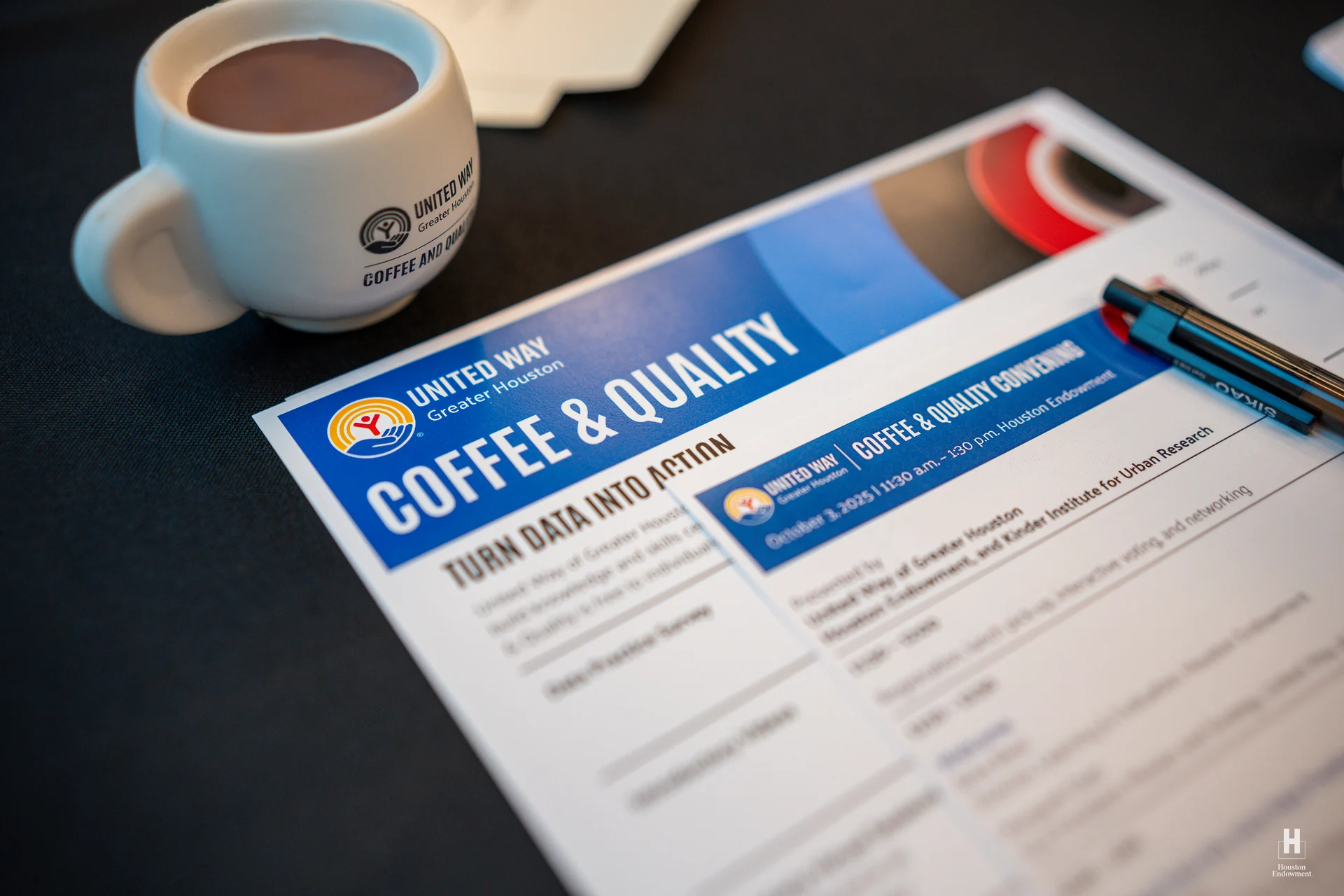
The partnership and data exploration was part of Coffee and Quality(opens in new window), a United Way of Greater Houston program that equips nonprofit professionals with data, evaluation, visualization, and storytelling capabilities to empower continuous quality improvement in their organizations.
Like Alexander JFS, many nonprofits across the region have utilized this free program to strengthen their organization’s performance through measurable learning and evaluation practices.
“Regardless of an organization’s mission, we’re looking to support how data practices fit into their environment and how they grow from their current state,” said Jessica Davison, assistant vice president of mission and strategy, United Way of Houston. “At the heart of it, Coffee and Quality is for all nonprofits.”
Building a Culture of Learning
Since its inception, and with the support of Houston Endowment, Coffee and Quality has expanded from a professional learning opportunity to a central hub of nonprofit data and evaluation knowledge. It comprises seven offerings including introductory videos, quarterly virtual sessions, learning cohorts, a fellows program, case studies, a data learners learning circle, and a data practice survey.
“We want grantees to have the skills and ability to collect data that’s meaningful, actionable, and can be used to inform their work,” said Brita Blesi, director of Learning & Evaluation at Houston Endowment. “Coffee and Quality is valuable because it can bring people together to collaborate and make data actionable. It uses multiple strategies and approaches to really build capacity for nonprofit organizations.”
Nonprofits can access Coffee and Quality offerings to sharpen their data skills at a cadence and volume that matches their needs. But for these lessons to prove impactful, program leaders note that an organization must maintain a data-driven culture alongside four conditions:
- Leadership buy-in and support for using data and evaluation in the organization;
- Resources, including staff, that are allocated and/or committed to data and evaluation practices;
- A commitment to continuously learning and growing as an organization; and
- Established data and evaluation practices.


A quest for continuous improvement
Leaders continue to look for ways to refine the program, ensuring its value and uptake throughout the nonprofit community.
Davison, in partnership with Dan Potter, director of the Houston Population Research Center at Kinder Institute of Urban Research, recently used the data practice survey to assess individuals’ confidence levels about the data practices within their organizations. The 2025 results were shared at a convening of nonprofit professionals held in October at Houston Endowment.
Results yielded positive feelings towards the program. Coffee and Quality participants were confident in using data practices in their role and felt similarly about data usage across their organizations.
“This improvement is particularly notable for those organizations who have been extra engaged with Coffee and Quality,” explained Potter. “As people and organizations double down into the Coffee and Quality space, it is translating on the back end to greater [organizational] improvements.”
He said that while respondents agreed on the value of Coffee and Quality, gaps in learning opportunities still exist. Data dictionaries and logic models were two practices respondents felt the least confident in enacting. Potter said efforts are already underway to bolster these skills through the program.
Nonprofit organizations are encouraged to visit the United Way of Greater Houston’s website(opens in new window) for more information and to participate in Coffee and Quality.

The Channel Newsletter
A monthly newsletter full of the work that moves us, the stories that inspire us, and the community that drives us.