Nine Gulf Coast community colleges join forces to expand economic opportunity
Listen to the audio transcription for this article:
With $33.2 million in grants from Houston Endowment, colleges are putting locally designed plans into action while working together to help more students earn credentials that lead to family-sustaining careers
Leaders from nine Gulf Coast community colleges gathered at Houston Endowment on Tuesday with a shared goal: helping more students complete their education and move into careers that provide a family-sustaining wage.

Dr. Kimberly Lowry, executive director of the Texas Success Center, emphasizes the importance of community colleges learning from each other.

Dr. Kimberly Lowry, executive director of the Texas Success Center, emphasizes the importance of community colleges learning from each other.

Dr. Kimberly Lowry, executive director of the Texas Success Center, emphasizes the importance of community colleges learning from each other.

Leaders from nine community colleges gathered at Houston Endowment on Tuesday to kick off the regional initiative.

Leaders from nine community colleges gathered at Houston Endowment on Tuesday to kick off the regional initiative.

Leaders from nine community colleges gathered at Houston Endowment on Tuesday to kick off the regional initiative.
Although their institutions serve different communities across a vast geographic area, the college leaders are grappling with many of the same challenges. And they recognize that working together could help them make progress faster.
“We’re building our own community as community colleges,” said Dr. Amanda Allen, president of Wharton County Junior College.
Allen described how college leaders and staff already reach out informally to their counterparts at other institutions to exchange ideas and solve problems. Now, they have an opportunity to make that collaboration more intentional.
“This is a way for us to really structure that work and say, ‘OK, we’re going to take the time to truly come together so that we’re not reinventing the wheel,’ ” she said. “You're going to look at my bicycle wheel, and I'm going to look at your Mack truck wheel, and we're going to figure out how to get all these wheels rolling together.”
The gathering marked the launch of a three-year, $33.2 million initiative funded by Houston Endowment to help more Greater Houston community college students earn credentials that lead to family-sustaining careers. The investment will support locally designed strategies at each of the nine colleges while creating opportunities for them to learn from one another, tackle shared challenges, and improve student outcomes across the region.
Creating pathways to economic mobility
Community colleges are central to economic mobility in Greater Houston. The nine Gulf Coast colleges enroll more than 195,000 students, and 53 percent of Greater Houston students who continue their education after high school choose a Texas two-year college. Yet only 37 percent of students who start at a community college in the region earn a credential, compared with 67 percent of those who start at a four-year institution. Among the region’s high school classes of 2014–2016, only 1 in 5 graduates was earning a living wage six years later.
Many community college students are balancing school with work and family: Four in five attend part-time, and three in five work 20 or more hours a week.
“We can’t ask them to work any harder. They’ve been working hard their whole lives,” Houston Endowment President and CEO Elisa Villanueva Beard told the college leaders. “And so we need to make sure that they have a path that works.”
The nine participating colleges are Alvin College, Brazosport College, College of the Mainland, Galveston College, Houston City College, Lee College, Lone Star College System, San Jacinto College, and Wharton County Junior College.
The new funding includes $32.2 million over three years for the colleges to implement their plans, along with $1 million over 18 months for the Texas Success Center, part of the Texas Association of Community Colleges, to coordinate regional learning and provide implementation support.
Each college developed its own approach based on its students and local circumstances, but common priorities emerged: clearer academic and career pathways, stronger advising and student support, and better data systems to help colleges identify when students are losing momentum. Together, these strategies aim to connect more students to high-value pathways and address barriers that can prevent them from completing their education.
The work builds on $500,000 planning grants Houston Endowment awarded to each college and the Texas Success Center in 2025, following the passage of House Bill 8, which shifted Texas community college funding from enrollment to student outcomes. Over the past year, the colleges used the planning grants to survey students, analyze their data, and develop their own strategies, with labor-market data, coaching, and several rounds of feedback along the way.
Now, they are moving from planning to implementation.
Learning together to improve student success
To inform the initiative, Houston Endowment partnered with Marzano Research to examine what other metropolitan regions are doing to improve community college completion and graduates’ earnings.
Researchers benchmarked community college outcomes across the nation’s 50 most populous metropolitan areas, examining both credential completion and earnings after graduation. They identified five high performing regions with characteristics that offered useful comparisons to Houston: San Diego, San Antonio, Denver, Chicago, and Tampa.
Dr. Trudy Cherasaro, director of research at Marzano Research, shared five approaches common among the higher-performing regions: proactive advising and student support; transfer pathways that protect students’ earned credits; workforce programs aligned with local employer needs; assistance with expenses beyond tuition, such as transportation and food; and dual-enrollment opportunities that help high school students get an early start on college credentials.
“One common thread across all of them was that all these things were kind of connected,” Cherasaro said. “Really tying all those pieces together was important for the student experience.” The research reinforced many of the priorities the Gulf Coast colleges had already identified through their planning work.
Kaylan Connally, education program officer at Houston Endowment, noted that while the nine institutions serve different communities, they are grappling with similar challenges. That creates an opportunity to test approaches, share lessons, and make improvements together rather than having each college solve the same problems independently.
Unlike many metropolitan regions, Greater Houston does not have a unified community college system. Its nine colleges are independently governed, each with its own leadership, priorities, and community needs.
The Texas Success Center will help bring the institutions together through data discussions, site visits, implementation coaching, and other opportunities to share what they are learning.
Dr. Kimberly Lowry, executive director of the Texas Success Center and vice president of the Texas Association of Community Colleges, emphasized that the goal is not to make all nine institutions operate the same way.
“For us, the opportunity to support you regionally is not so that there is just uniformity in all the institutions, but that we learn together, we grow together,” she said.
Lowry stressed the importance of learning not only from successes but also from approaches that don’t work as expected. Those lessons could help other colleges avoid similar challenges and accelerate progress.
But the work is about more than improving institutional performance, she said.
“I remember early in my higher education career, I used to always say, ‘We are transforming lives and saving dreams.’ And I still believe that to this day,” Lowry said. “It is not just about the enrollment. It is not just about the headcount. It is about the work we’re doing to help change people’s lives.”
The collaboration could also produce insights for community colleges across Texas and nationally.
“I think what excites me truly is the opportunity to build something together that I don’t think one institution could do alone,” Lowry said.
From planning to action
In remarks following the panel discussion, Villanueva Beard emphasized that the Foundation’s role is not to prescribe solutions but to support the expertise and leadership already present at the colleges.
“We do not have the answers. We know that. You all have the answers. You know your communities. You know your students,” Villanueva Beard told college leaders following the panel discussion.
She emphasized that the Foundation’s role is to help colleges define challenges, design solutions, take thoughtful risks, and share what they learn so that progress can happen more quickly. She also challenged college leaders to confront the region’s educational and economic realities while remaining confident that change is possible.
“Houston, as we all know, is not short of jobs,” she said. “What we’re missing … is we need the rungs on the ladder.”
Credentials that lead to meaningful careers, she explained, can provide those rungs.
Drawing on her own family’s experience, Villanueva Beard described how her parents, Mexican immigrants who raised their children in South Texas, viewed education as a path to independence and opportunity.
“For my family, that degree and education was not about status. It was about freedom,” she said. That same opportunity, she told the college leaders, should be available to the nearly 200,000 students they serve.
“We want to be the place where young people, young adults say, ‘Where should I live?’ You should live in Houston once you graduate from high school because Houston is going be the number one place that provides credentials of value, where it leads to a job with a living wage.”
The work ahead will be difficult, particularly as colleges continue serving today’s students while making changes for the future, she acknowledged, but no institution has to take on that challenge alone.
“That one in five number, that is reality for us. That can change,” she said. “But it will not change unless we do this together.”

The Channel Newsletter
A monthly newsletter full of the work that moves us, the stories that inspire us, and the community that drives us.
Related Posts
-

Community colleges get a boost toward supporting workforce readiness
Learn More (Community colleges get a boost toward supporting workforce readiness) -

Houston Endowment awards $5 million to support postsecondary success at 9 area community colleges
Learn More (Houston Endowment awards $5 million to support postsecondary success at 9 area community colleges) -
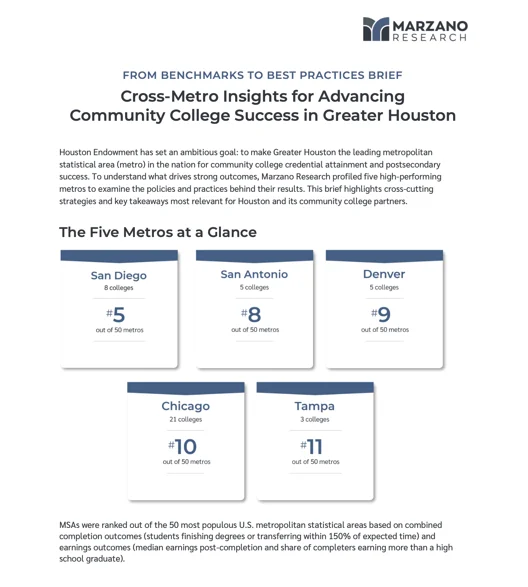
From benchmarks to best practices brief: Cross-Metro Insights for Advancing Community College Success in Greater Houston
Learn More (From benchmarks to best practices brief: Cross-Metro Insights for Advancing Community College Success in Greater Houston)