Planning a clear roadmap for historic investment in teacher preparation
Three months after historic legislation earmarked $400 million for teacher preparation efforts, leaders from regional school districts and educator preparation programs (EPPs) gathered to map out a plan forward. Meeting at Houston Community College–Southeast, the Houston Region Teacher Pipeline Community of Practice dug into the sweeping changes: new retention-based pay raises built into state formulas, an expanded Teacher Incentive Allotment, and the state’s first sustained investment in high-quality pathways such as residencies, student teaching stipends, and Grow Your Own programs.
Since 2022, Houston Endowment has funded the Community of Practice to bring stakeholders together around best practices in teacher preparation, including innovative and effective staffing practices.
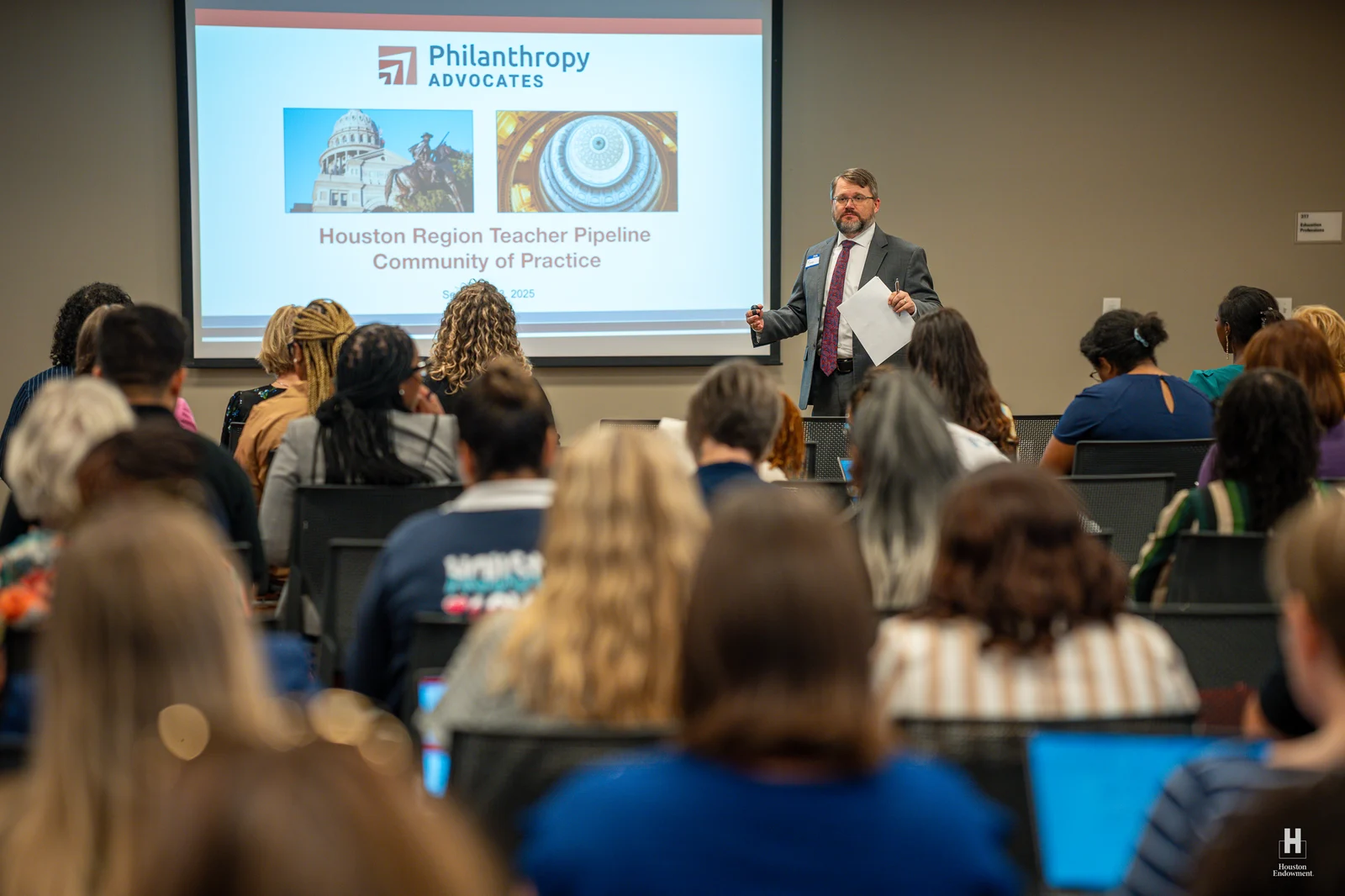
“This is a substantial investment and it should be an investment that lasts and is able to grow over time,” said Ryan Franklin of Philanthropy Advocates(opens in new window), who briefed attendees on the new policy landscape. “There was an intentional focus on teacher retention and recognizing those points where we lose teachers—as well as the points where our teachers are getting better and having greater impact on student learning.”
In June, Texas lawmakers passed House Bill 2, which nearly doubled expected funding for education, and directed billions toward teacher pay, preparation, and retention. A central aim of the legislation is phasing out uncertified teachers in core subjects—starting with K–5 reading and math in 2026–27 and extending to all core subjects by 2029–30—while building the pipeline to replace them. That urgency aligns with recent research showing that students taught by unlicensed or uncertified teachers experience measurable learning losses and those teachers exit the classroom at higher rates.


As part of HB 2, $400 million annually will be directed into high-quality routes such as yearlong residencies, student-teaching stipends, pre-service alt-cert pathways, and mentor teacher support, with Grow Your Own (GYO) programs receiving $8,000–$12,000 per district employee moving toward certification. Funding will be outcomes-based: EPPs receive their share after a candidate earns certification and completes one year as teacher of record, and districts receive the second half of their allotment after certification is achieved.
“For the first time, this is an investment in effective preparation routes,” Franklin said.


Among Texas’ four largest urban centers, Greater Houston has the highest share of uncertified teachers at 12 percent. Research shows a significant impact: uncertified teachers are almost twice as likely to leave the classroom compared to their certified peers — 64 percent versus 34 percent within the first five years. Also, students taught by uncertified teachers with no prior classroom experience lose an estimated four months of learning in reading and three months in math compared to peers with certified teachers. This churn destabilizes schools and compounds inequities, particularly in high-need communities.
“Teachers are the single most important in-school factor for student learning,” said August Hamilton, Program Director for Education at Houston Endowment. “We need to create conditions for teacher candidates to achieve certification and enter the classroom highly prepared to help our students succeed.”
To become a certified teacher in Texas, a candidate must: (1) earn a bachelor’s degree, (2) complete an educator preparation program (EPP), and (3) pass the required certification exam. Unfortunately, many candidates face challenges in the process; the costs are high, the time intensive, and the transition from one step to the next complex.
CoP participants highlighted communication as a make-or-break issue: teachers, paraprofessionals, and prospective candidates need simple, clear information about stipends, residency options, GYO supports, and new pay pathways.
The Channel Newsletter
A monthly newsletter full of the work that moves us, the stories that inspire us, and the community that drives us.