Rewriting the playbook: What happens when nonprofits get real support to use data
Lessons from community-based, co-designed initiative published in The Foundation Review
When a youth-led nonprofit in Southwest Houston joined a Houston Endowment program in 2023, its team had big ambitions and genuine uncertainty about how to measure them. “We had a lot of ideas,” said AliefVotes Executive Director Abby Triño, “but we weren’t really sure how to put pen to paper and then to programming.”
Two years later, AliefVotes had built a dedicated data and records team, required new hires to have data backgrounds, and surpassed its nonpartisan voter engagement goals by more than 700 percent. Along the way, Triño became a co-author on a peer-reviewed journal article about what made that transformation possible.
That article, published this month in The Foundation Review(opens in new window), draws on surveys, interviews, and program data from Houston Endowment’s Harnessing the Power of Data initiative to ask a deceptively simple question: what actually helps nonprofits get better at using data to understand and improve their work?
The answer, it turns out, depends a great deal on how you ask—and who gets to define “better.”
Rethinking the rules of the game
Many funders approach data and evaluation training with a familiar set of assumptions: that organizations need to be pointed toward the “right” practices, that requiring participation is the best way to ensure it, and that success means meeting externally defined metrics. Harnessing the Power of Data was designed to challenge all three.
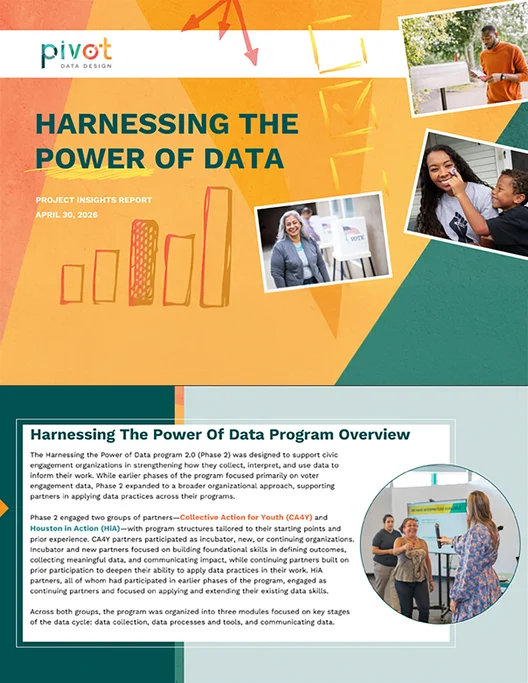
Houston Endowment launched the initiative in 2023 in partnership with Pivot Data Design(opens in new window), a data and evaluation consultancy, and two community-based backbone organizations that work with nonprofits focused on nonpartisan civic engagement across Greater Houston. Rather than deploying a standard curriculum and expecting uniform participation, the team started by listening.
A four-month planning phase, which focused entirely on relationship-building and understanding the existing strengths and constraints of partner organizations, shaped everything that followed. Partner organizations were placed into cohorts based on where they were starting from, not a funder’s idea of where they should be. Participation was voluntary, supported by stipends ranging from $5,000 to $20,000 per year, and designed to flex alongside organizational realities like staff turnover and the intense seasonal program demands.
That upfront investment in co-design had a lasting effect. Houston Endowment found it so valuable that the foundation has since adopted a planning-first model as standard practice across all of its evaluation contracts.
What the data showed
The program served 65 nonprofit organizations over two years, and the results were measurable well before anyone expected them to be.
One way to assess whether the program improved nonprofits’ data collection capacity was through the “match rate,” a common metric of data quality and accuracy for voter outreach work. Within the first year of the program, the average match rate across partner organizations rose 32 percentage points, from 55% to 87%. Organizations with higher levels of program participation saw even greater gains.
That improvement wasn’t just a technical achievement. It reflected a shift in how organizations understood the purpose of data collection in the first place, from a compliance obligation to a tool for their own learning and storytelling.
By the program’s end, partner organizations weren’t just tracking numbers more accurately. They were using data to sharpen grant proposals, redesign programs, train staff, and make the case for their work to boards and community members. Many had built internal systems—dashboards, workflow guides, logic models—designed to outlast any individual staff member.
Flexibility and structure: not opposites
One of the paper’s most practical insights is about how flexibility and structure interact. The program found that flexibility alone wasn’t enough to sustain engagement. What worked was pairing genuine flexibility with clear scaffolding: defined timelines, active facilitation, and specific next steps that made participation easy to fit into a busy calendar.
This played out in how the program handled participation agreements. Early in the initiative, organizations signed fixed commitments upfront. Midway through, the team shifted to what they called “Living Agreements”—periodic check-ins where organizations could adjust their level of involvement based on what was actually happening in their work. That shift reduced friction and increased engagement.
When a later cohort was allowed to try the program before committing to a participation level, 78% engaged at medium or high levels compared with an average of 49% across cohorts that had made commitments in advance.
Triño described the approach from a participant’s perspective: “I was a little skeptical in the beginning … But I commend Pivot Data for allowing us to have flexibility. It wasn’t like we need to meet today or else … I really appreciated that. I love that they were intentional with the partnership.”
Stipends opened the door,
relevance sustained the work
The role of financial support also emerged as more nuanced than a simple carrot-and-stick dynamic. Organizations that participated in the program received stipends based on their size and level of participation. These financial incentives played an essential role in securing buy-in, especially for volunteer-led organizations.
Several organizations used the funds to build internal infrastructure: data tracking systems, dedicated staff roles, and improved reporting processes. In these cases, stipends went beyond serving as an incentive, strengthening the organizations’ internal capacity to adopt data and evaluation practices.
But stipends alone didn't keep organizations engaged over time. What sustained participation was whether the learning felt relevant and connected to real work, and whether the relationships built through coaching and peer networking made the effort feel worthwhile.
As the paper puts it, incentives make entry possible, but meaningful participation endures when evaluation feels useful and aligned with organizations’ real-world work.
About 40% of partner organizations were categorized as low-participation by the program’s end, often because of limited staff capacity or shifting organizational priorities. That reality is part of the honest accounting the paper offers: even a well-designed, well-resourced program can't remove every structural barrier. But it can remove the unnecessary ones.
A community of practice, not just a curriculum
Perhaps the most durable outcome of Harnessing the Power of Data wasn't any individual skill or tool—it was the network of relationships that formed among the 65 participating organizations. Peer networking and “Progress Partners” pairings gave organizations space to learn from one another, normalize challenges, and share strategies across organizations that were often working in similar communities toward similar goals.
Annual showcases gave partner organizations a chance to present their data work to local stakeholders, situating their individual progress within a broader civic ecosystem. Staff were supported to attend evaluation conferences. Local networking opportunities connected them with data and evaluation professionals across Greater Houston.
Houston Endowment Learning & Evaluation Officer Robiel Abraha observed: “Data and evaluation is becoming a big part of the culture of a lot of these nonprofit and grassroots organizations. It’s helping them both focus their work as well as making sure that they have a North Star for what they're doing.”
What comes next
The lessons from Harnessing the Power of Data have already shaped a second iteration of the program, which launched in 2025 with refined learning pathways, clearer coaching structures, and timelines more closely aligned with organizational readiness and the rhythms of election cycles. Publicly available resources, including practical tools and guidance for funders and practitioners, are available at HoustonEndowment.org/powerofdata.
The journal article itself is a form of that knowledge-sharing: a collaboration among foundation staff, the consulting partner, and a grantee organization, offering the field an honest, evidence-based account of what trust-based capacity building looks like in practice.
For Abby Triño, the experience was transformative in ways that go beyond data. “Youth organizing is often viewed as an entry-level job,” she wrote in the paper. “The capacity for these roles is underestimated, and so is the support provided to them by leadership.” Harnessing the Power of Data, she said, changed that calculus at AliefVotes, and proved that when young people are given real support and a real seat at the table, they will show up fully.
Unpacking Assumptions: What Evaluation Capacity Building Looks Like When It's Optional, Flexible, and Funded(opens in new window) is published (open access) in The Foundation Review(opens in new window), Vol. 18, Issue 2. Authors include Jennifer Marsack (Pivot Data Design(opens in new window)), Martena Reed (Reflect Evaluation(opens in new window)), Robiel Abraha, Sara Jones, and Brita Blesi (Houston Endowment), and Abby Triño (AliefVotes(opens in new window)).

The Channel Newsletter
A monthly newsletter full of the work that moves us, the stories that inspire us, and the community that drives us.