The Hardest Love We Carry
Listen to the audio transcription for this article:
The Hardest Love We Carry looks at the ways people find strength to keep moving forward: through humor, effort, and creativity. Rather than treating resilience as something innate, the four artists’ work suggests it is something practiced–a muscle strengthened over time. Their hope is one of ingenuity and endurance in the face of challenges.
Installed January 2026
Curated by Weingarten Art Group
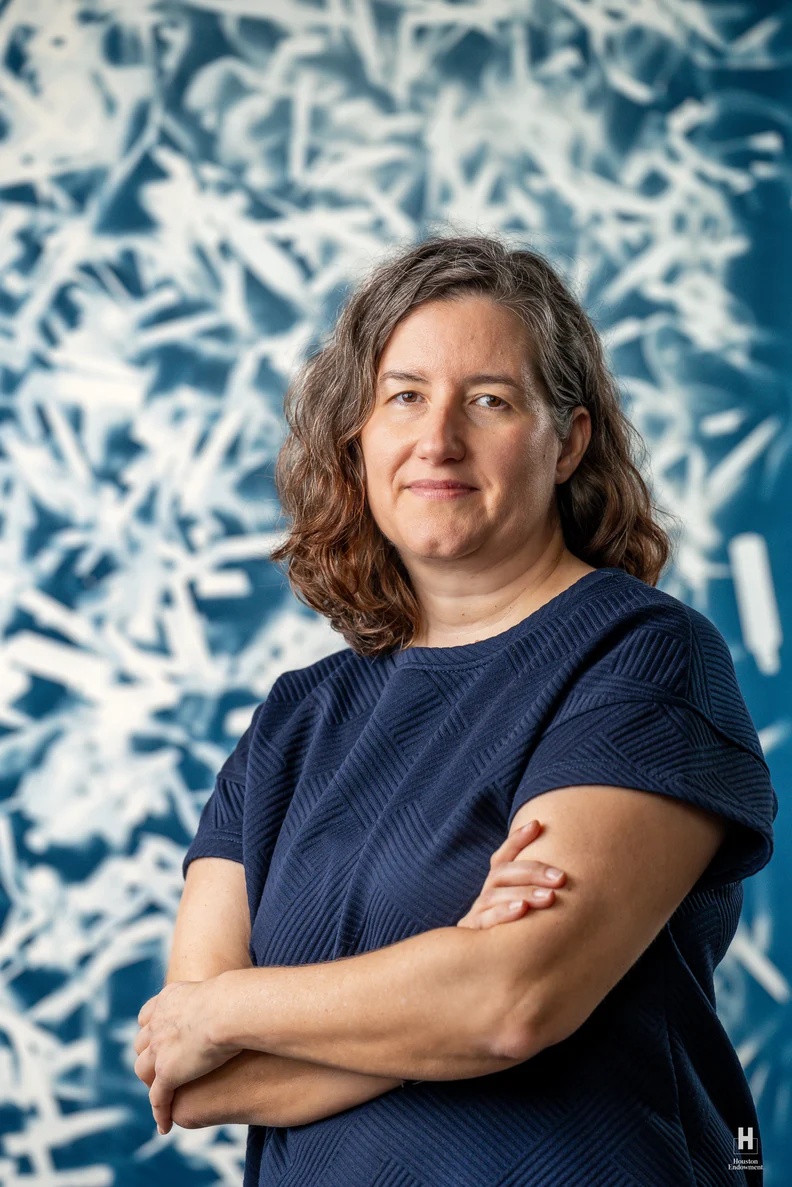


Keliy Anderson-Staley
Staley’s Unbound is made from hundreds of hospital wristbands worn over the course of her ongoing, three-year experience with breast cancer and autoimmune disorders.
Through the cyanotype process, the wristbands are transformed into densely clustered and luminous abstract forms. The personal data that once defined them falls away, leaving only their shapes and machine-cut perforations—familiar but no longer tied to any single person’s story.
In their sheer number, the bands register the duration and demands of long-term treatment, while also beginning to suggest something cosmic or organic. What emerges is a portrait of care as sustained effort. It is repetitive and demanding, yet carried by hope and the possibility of healing.


Brian Edwards Jr.
In his series On My Way Home, Edwards documents Black cowboy culture in Dayton, Texas. After time away, Edwards returned home, guided by the words of a family friend who told him, “Everything you need is right here.”
The images move between action and stillness, foregrounding the physical demands of this way of life. A black-and-white photograph captures a cowboy in mid-gesture, lifting a lasso into the air. In another, three figures on horseback appear in silhouette against a darkening blue sky. A portrait of a young man at a rodeo meets the viewer’s gaze directly, while a nighttime rodeo scene shows horses and riders in the excitement before a crowd.
Together, these images reframe the Black cowboy as an everyday presence grounded in the rhythms of daily life. On My Way Home is both documentation and preservation—a living archive that carries this legacy forward.


Jessica Carolina González
González’s work from her series Es Una Lucha, which translates to “It’s a Struggle,” a body of work that examines how personal histories are shaped by systems of authority. The six works combine family photographs with scans from her mother’s U.S. immigration records.
The series began in 2016, as González navigated the legal process of sponsoring her mother’s residency and was asked to assemble images from her family archive to demonstrate what would be lost if that status were denied. That encounter with bureaucratic scrutiny became the catalyst for this work.
Here, González layers family moments with official documents, refusing to let the two narratives exist separately. Images of care, motherhood, and everyday life appear alongside asylum requests, work authorizations, and biometric data. The emotional weight of this process is palpable, and it becomes much more than documentation—it is a love letter to her family and an assertion of dignity and presence.


Hillerbrand + Magsamen
Hillerbrand + Magsamen work collaboratively across photography, performance, and sculpture. Using everyday materials, they imagine new ways of holding life together through play and improvisation.
Their series 147 Devices for Integrated Principles features whimsical contraptions they have built from household objects. The devices are “imagined tools designed to solve life’s most impractical and impossible problems,” including attempts to forget, forgive, and keep life in motion. The works are intended to be absurd, yet lovingly sincere.
Inspired by their experiences weathering Houston storms, the works are about times in life when resilience requires resourcefulness. The series embraces the relentless pace of life and responds by inventing ways forward.

The Channel Newsletter
A monthly newsletter full of the work that moves us, the stories that inspire us, and the community that drives us.